

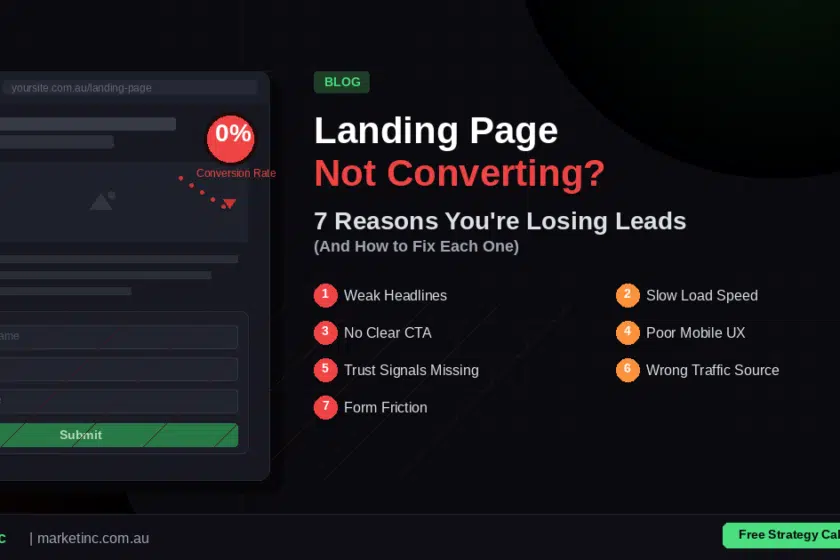
Landing Page Not Converting? 7 Reasons You’re Losing Leads (And How to Fix Each One)
You’re spending good money on Google Ads. Your SEO is bringing in steady traffic. The numbers in your analytics dashboard look healthy.
But when you check your actual leads? Nothing.
If that sounds like your situation, you’re not alone. It’s one of the most common frustrations we hear from Sydney business owners: “I’m getting traffic, but nobody’s picking up the phone or filling out the form.”
The good news? A landing page not converting is almost always a fixable problem. And in most cases, you don’t need more traffic; you need to fix what’s happening once people arrive.
In this guide, we’ll walk you through the seven most common reasons landing pages fail to convert, how to diagnose the real issue, and what practical fixes actually move the needle.
The Short Answer
If your landing page is getting traffic but not generating leads, the problem usually comes down to one or more of these seven issues:
- Weak headlines that don’t match what the visitor searched for
- Slow page speed, especially on mobile
- Vague or buried calls to action that don’t tell visitors what to do
- Missing trust signals like reviews, case studies, or certifications
- Long or intrusive forms that ask for too much too early
- Poor mobile experience with hard-to-tap buttons or broken layouts
- Wrong traffic, the page is fine, but the audience isn’t right
The fix isn’t usually a full redesign. Most of the time, targeted changes to one or two of these areas can dramatically improve your landing page conversion rate. For reference, most high-performing service business pages in Australia convert between 3–8% of visitors into leads. If you’re below 2%, there’s almost certainly low-hanging fruit to grab.
Now, let’s break down each issue and what to do about it.
The Real Reasons Your Landing Page Isn’t Converting
1. Your Headline Doesn’t Match What the Visitor Searched For
Your headline is the first thing visitors process, and they decide in seconds whether to stay or leave. If it’s vague, generic, or focused on your business rather than their problem, they won’t stick around.
The most common mistake we see with Sydney businesses? Headlines that talk about the company (“We’re the best at X”) instead of confirming the visitor is in the right place (“Need X fixed fast? Here’s how we help”).
A strong headline does two things: it matches the intent behind the search, and it promises a clear outcome.
Quick fix: Look at the search terms or ad copy driving traffic to your page. Does your headline directly mirror that language? If someone clicks an ad for “emergency plumber Sydney” and lands on a page that says “Welcome to Our Plumbing Services,” you’ve already lost them.
2. Slow Load Times Are Killing Your Conversions Silently
Even a few extra seconds of load time can tank your conversion rate, especially on mobile. Visitors arriving from paid ads are particularly impatient. They’ve clicked, expecting instant answers, and if the page takes too long, they’ll hit back and click on your competitor instead.
This one is sneaky because you might not notice it yourself (you’re probably testing on a fast office connection), but your customers on mobile data absolutely feel it.
Quick fix: Run your page through Google’s PageSpeed Insights (it’s free). If your mobile score is below 50, that’s a problem. Common culprits: oversized images, unnecessary scripts, and cheap hosting.
3. Your Call to Action Is Vague, Hidden, or Both
This is one of the simplest issues to fix and one of the most common reasons for website traffic with no leads. Many pages either bury their CTA below the fold, use weak copy like “Submit” or “Learn More,” or give visitors too many options at once.
Your CTA should be obvious, specific, and low-risk. Visitors need to know exactly what happens when they click, and why it’s worth their time.
Quick fix: Replace generic CTAs with benefit-driven ones. Instead of “Submit,” try “Get Your Free Quote.” Instead of “Learn More,” try “See How We Can Help Your Business.” And make sure your primary CTA is visible without scrolling on both desktop and mobile.
4. You’re Missing the Trust Signals That Close the Deal
Here’s something we see constantly: a page that looks professional, has decent copy, and a clear offer, but still doesn’t convert. The missing piece? Trust.
If visitors can’t quickly verify your credibility, they won’t take action. This is especially true for service businesses in Sydney, where competition is fierce,e and customers have been burned before. They need proof that you deliver.
Missing reviews, no case studies, no visible certifications, no real team photos, no ABN or physical address; any of these gaps can be enough to make a visitor hesitate.
Quick fix: Add at least two to three trust elements above the fold: Google reviews, a client testimonial, industry certifications, or a “trusted by X businesses” line with logos. Real proof beats polished design every time.
Rather, skip the DIY approach? If you’d rather have our team pinpoint exactly what’s costing you leads, we offer a Free Strategy Call where we’ll analyse your landing page and show you what needs to change. No obligation, just clarity.
5. Your Form Is Asking for Too Much Too Soon
Every extra field on your form increases the chance that someone abandons it. Asking for a phone number, company size, budget range, and a detailed message before someone even knows if you’re the right fit? That’s a conversion killer.
The goal of your landing page isn’t to qualify every lead perfectly upfront. It’s to start the conversation.
Quick fix: Cut your form down to the essentials: name, email, and one qualifying question at most. You can always gather more details on the follow-up call. We’ve seen Sydney businesses double their lead volume just by removing two or three unnecessary form fields.
6. Your Page Doesn’t Work Properly on Mobile
More than half of web traffic in Australia now comes from mobile devices. If your landing page looks great on desktop but has tiny tap targets, text that requires zooming, or a layout that breaks on smaller screens, you’re losing a huge chunk of potential leads.
The frustrating part? You might not even know it’s happening if you’re only checking your page on a laptop.
Quick fix: Test your page on at least three different mobile devices. Check that buttons are easy to tap, forms are simple to fill in, and the CTA is visible without excessive scrolling. If your web design is more than two to three years old, a mobile-focused rebuild might be overdue.
7. It’s Not the Page — It’s the Traffic
Not every conversion problem is a page problem. If your ads target broad keywords or your SEO is ranking you for informational searches rather than high-intent ones, visitors may never have been likely to convert in the first place.
The tell? If visitors land on your page and leave within a few seconds, it’s likely a traffic mismatch. But if they spend time on the page reading, scrolling and still don’t act, the problem is almost certainly on-page friction.
Quick fix: Review your top traffic sources. Are your Google Ads targeting specific, high-intent keywords (like “pest control Sydney” rather than just “pest control”)? Is your SEO strategy focused on commercial intent, not just traffic volume? Sometimes the best way to improve landing page conversions isn’t touching the page at all; it’s refining who sees it.
What This Looks Like When It’s Done Right
Here’s a real example from one of our Sydney clients:
The client: A home services business in Western Sydney getting 1,800+ monthly visits to their main landing page but averaging just 4 leads per month.
The problem: Slow mobile load time (7+ seconds), a generic headline that didn’t match their ad copy, a 9-field form, and zero visible reviews on the page.
What we did: Compressed images and moved to faster hosting (load time dropped to 2.1 seconds). Rewrote the headline to match their top-performing ad groups. Cut the form to 3 fields. Added Google reviews and a mini case study above the fold.
The results (within 8 weeks):
- Load time: 7.2s → 2.1s on mobile
- Form submissions: 4/month → 27/month
- Conversion rate: 0.2% → 3.8%
- Cost per lead from Google Ads: Dropped by 61%
No extra ad spend. No redesign. Just targeted fixes based on the issues we’ve outlined above.
Want to see what’s possible for your business?
Three Things You Can Do Right Now
If you’ve made it this far, you’re serious about fixing your conversions. Here are three things you can do today, each takes under 30 minutes:
- Test your page speed on mobile. Go to PageSpeed Insights and enter your landing page URL. If your mobile score is below 50, start by compressing your images and removing any scripts you don’t need.
- Count your form fields. If you have more than four, ask yourself which ones you truly need before the first conversation. Cut anything that isn’t essential for making contact.
- Check your headline against your top traffic source. If your best-performing ad or top organic keyword says one thing and your headline says something different, that mismatch is costing you leads.
These won’t transform your results overnight, but they’ll show you exactly where the gaps are.
Frequently Asked Questions
- Why is my landing page getting traffic but no leads?
This is almost always caused by a disconnect between what visitors expect and what the page delivers. The most common culprits are weak headlines that don’t match search intent, slow page load times (especially on mobile), vague or buried calls to action, and missing trust signals like reviews or case studies. The good news is that these are all fixable without rebuilding the page from scratch.
- What is a good landing page conversion rate?
For most Australian service businesses, a well-optimised landing page converts between 3–8% of visitors into leads. Some industries with high urgency (like emergency plumbing or pest control) can push above 10%. If you’re sitting below 2%, there are almost certainly structural issues holding your page back that targeted changes can address.
- Can SEO traffic convert worse than paid traffic?
It can, and it often does if your SEO strategy is targeting informational keywords rather than commercial ones. Someone searching “what is a landing page” has a very different intent from someone searching “landing page design Sydney.” Aligning your keyword strategy with buyer intent is key to getting leads from organic traffic, not just visits.
- Do small changes really improve conversions?
Yes, and often significantly. We’ve seen headline rewrites, form simplifications, and speed improvements individually lift conversion rates by 50–200%. You don’t always need a full redesign. A structured audit that identifies the one or two biggest friction points usually delivers the fastest ROI.
- Should I fix the page or the ads first?
Fix the page first. If your landing page has friction, even the best-targeted ads won’t convert efficiently. Improving your page means every dollar you spend on Google Ads and every visitor from SEO works harder for you. Once the page is converting well, then optimise your traffic sources.


